Posts in Education & Training
Making Vocational Training Work for Regional Communities

The new year brought confirmation of ten re-established polytechnics across Aotearoa New Zealand, including SIT, Ara, EIT, NMIT, Toi Ohomai, Wintec, Unitec and MIT, Otago Polytechnic, UCOL and The Open Polytechnic. It’s a significant moment, but it also raises the question: what could autonomy in the regions enable?

Vocational training in the regions takes a community. Times have changed and so have the needs and aspirations of learners and industries. Industries are pivoting faster than ever, and expecting a centralised, siloed model of education and training to keep up is increasingly risky. Regional providers with local governance are far better placed to understand what is happening on the ground and to develop programmes and delivery modes that respond to real gaps in skills and capability.

While the regional institutions identified as sustainable will be relieved to continue this work, ten polytechnics alone will not fill the skills gaps across the country. Some regions will remain underserved. Learners can move or enrol in online qualifications, but attrition in remote programmes is high because the model simply does not work for many people. Onsite hands-on learning builds communities, and when it comes to work, having access to face-to-face industry and community networks who can support your learning journey is crucial.

One of the most visible gaps is for people already in work. Learning pathways are still largely designed for school leavers, who can dedicate months or years to full-time study. For those in full- or part-time work, often supporting families, this is rarely possible. After more than a decade in the sector, I have seen how limited the options are for people to grow or shift their skills in the places they live and work. We all can and should continue to drive our own learning, and access to online resources has never been greater, but the development of hands-on skills and capabilities that are relevant to regional contexts must be embedded in communities and workplaces. Learning is no longer a destination, as it was once viewed. Upskilling and retraining while in work are now fundamental to supporting thriving regions.

So how might newly announced regional autonomy begin to serve those who are currently underserved? Most regions will not see it as viable or desirable to encourage people to leave to train, nor is it practical for many to do so. Regions now have the chance to establish their own models for growth around identified gaps. There is a real opportunity to reimagine delivery so that learning is embedded in workplaces and local industries, with facilitated, blended training that fits around work rather than requiring people to step away from it. Learning and working life are intertwined, and regions are best placed to determine how skills development connects with their industries and communities.

If we are serious about thriving regions and sustainable local economies, learning must be designed and delivered to fit the lives of learners while strengthening the communities around them. Regional providers, industry partners, and communities can now work together to shape models of vocational learning that are accessible, practical, and deeply connected to local needs. This is how skills development can support both people and places, creating thriving communities where learning is part of everyday life.

Be a lifelong learner

I started my ‘formal’ tertiary education at the Dunedin School of Art, completing a four-year degree followed by a two-year masters. It sounds like a long time now, but at the time it was standard, and like all periods filled with activity, it flew by. I finished my degree and chose to continue straight into my masters because I felt I had more to learn, I was in the ‘zone’ in terms of navigating that learning environment, and I could already see how hard it was for those with greater financial commitments to step back into study.

What I also learned in art school is that learning never ends. The more you learn the less you know. That really did ring true for me. And although I have spent much of my life in learning institutions, learning itself is not confined to them. It can happen anywhere and at any time, and we are now in a moment when learning has never been more accessible. We can choose learning that fits with the contexts we are navigating.

Many institutions still treat learning as a destination, where you acquire a qualification which signals that you have arrived and will now naturally progress to your aspired place in the world. This does both learners and institutions a disservice, because generally a qualification is not a ticket or a pass to anything. Educational institutions often boast that qualifications result in better employment outcomes such as earning more in the long term. However, rather than the acquisition of a qualification, what really matters is the active pursuit of learning in whatever form that takes.

There are ongoing debates about the relevance of tertiary qualifications, especially in relation to how quickly graduates transition into work. This is an ongoing challenge for institutions whose funding models and historical ways of operating struggle to support the kind of agility the working world now demands. That does not mean there is no value in undertaking a qualification. When I later completed a PhD, I knew the credential mattered less than being supported to pursue research in the real world, and to keep learning as part of how I work.

Those who treat education as a destination, and who prioritise maintaining the status quo over learning, are inevitably steering themselves into irrelevance. You have never arrived. A qualification is not a ticket or a right to the working life you imagine. Lifelong learning is not something an institution gives you — it is something you choose, again and again, as the world, and your place within it, keeps changing.

Embrace Limitations

When I was at art school, I lived off a student allowance, which meant a very lean life with little room for expenditure beyond rent, power, phone, and food. I didn’t have internet at home, or my own laptop. I made black coffee in a pot on the stove, later upgrading to a stovetop coffee brewer I found for $2 at an op shop. I slept on a mattress on the floor with a broken bed base, owned an old antique dressing table, and put cash into jars each week to make sure I could keep the power and phone on.

Most winters I froze and went to bed fully dressed, wearing a beanie and using two hot water bottles. My first flat was a concrete-block, two-bedroom unit with a one-bar heater. Each morning I woke to condensation streaming down the walls. I owned an old second-hand television that worked sometimes but had an ancient video player that worked just fine—aside from the occasional moment when I had to unscrew the top to rescue a chewed tape.

There was a shared washing machine with two tubs, requiring mid-cycle load swaps. I walked long distances to art school, to buy groceries, pay bills, and visit op shops, only occasionally taking the bus. I kept spare clothes in my locker at school because arriving soaked was not uncommon in Dunedin.

None of this felt unusual. And this isn’t a story about hardship—I was happy. I was making my own way in the world and had the opportunity to attend art school and learn from people I admired. I became an avid op shopper and attended auctions, amazed by how much could be acquired for so little.

I committed fully to painting and took every opportunity to do commissioned work: portraits of children, pets, houses, and gardens. When I started, I had two paintbrushes and three colours—black, white, and red. I made my own canvases at art school. Later, a local art supply store allowed me to open an account, paying $10 a week so I could gradually buy more brushes and colours. I painted constantly, developing strategies to work with what I had.

For a large-scale commission, I woke at 4am to paint for three hours before my flat mates woke. The canvases were too large for my bedroom, so I unpacked and repacked them daily.

I didn’t need much to begin. I worked for years with a 35mm camera a friend loaned me, bought 120mm cameras at auctions, and still use two old tripods—one bought for $15 thirty years ago, the other found abandoned.

Limitations became my greatest ally. The skills I learned served me well when I took my first paid role in the non-profit museum sector, where budgets covered little beyond salaries and modest programme costs. Fundraising was routine, and doing a lot with a little was simply how things were done.

Creativity thrives on constraint. Limitations force choices, sharpen focus, and build resilience. Working with less taught me how to begin, how to persist, and how to solve problems rather than wait for ideal conditions. Abundance, by contrast, can often be a hindrance to creativity, encouraging hesitation, distraction, or the pursuit of perfection. These lessons continue to inform my creative practice, reminding me that meaningful work rarely depends on having more but just on getting started.

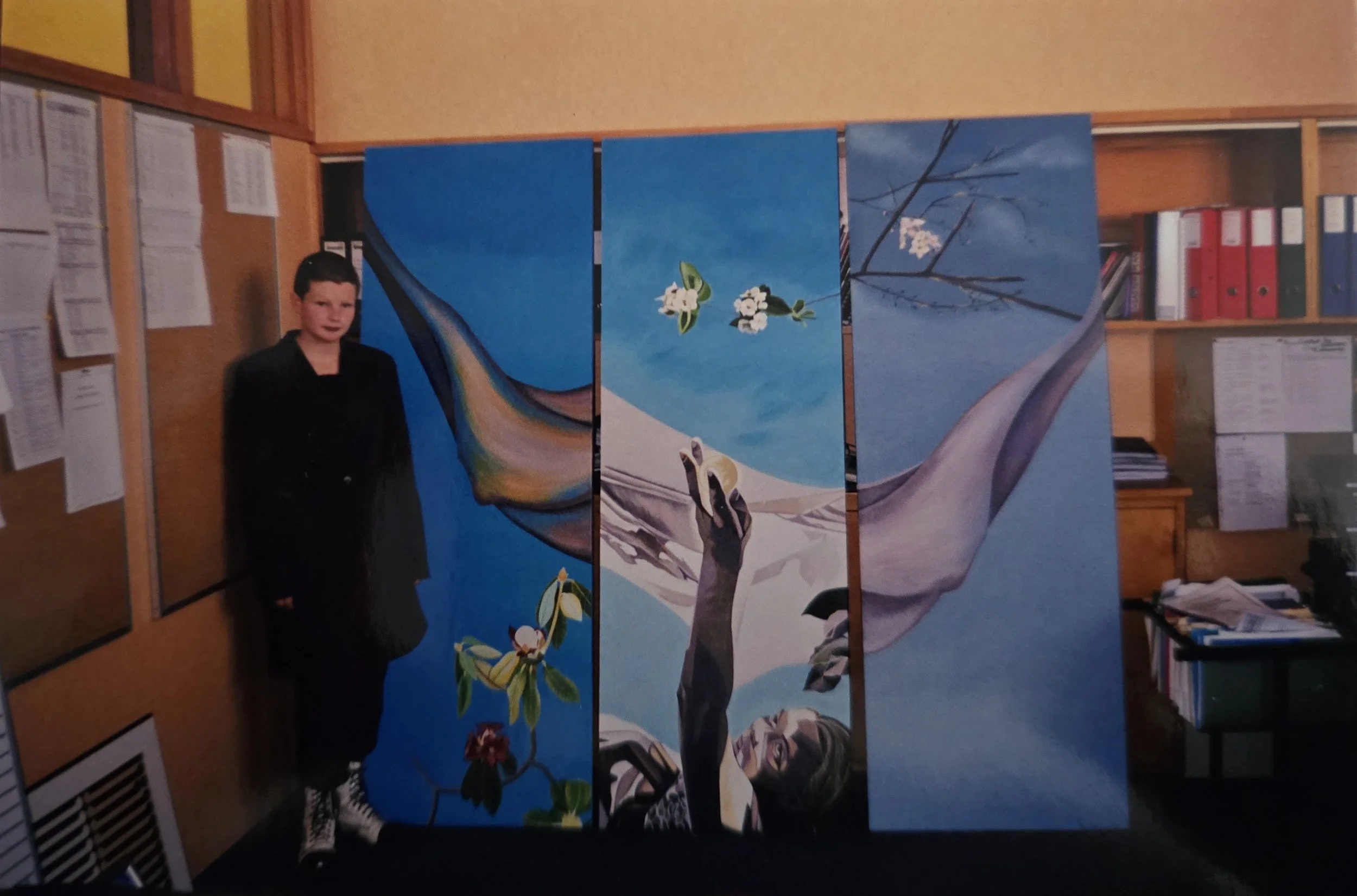
Commission for Dunedin Hospital, 1999.
On Books and Remembering

As I was searching our bookshelves for a particular quote I wanted to reference this morning, I thought again about books as objects/artefacts. Yes, I am old enough that I completed both my master’s and PhD before the advent of AI, and while I used online sources, I relied heavily on books.

I remembered the substance of the quote and the author, and I was able to locate the book fairly quickly from our very large, unorganised (and somewhat out of control) book collection. Why was I able to access the book so quickly? Because I remembered the book as an object: its size, the colour of its spine, and the cover. A skill that was likely fundamental to the research I was engaged in.

When completing my masters, referencing was done manually, and you learned your lesson very quickly if you did not make note mentally or physically of an important source. This made me think of the connection formed with a book as a physical object that is handled, paged through, post-it filled, marked, and notated. Books that hang around the house, lying open at pertinent pages. Books that are packed in bags and carried around. That are lived with. That are valued as artefacts.

If I used online articles, I was in the habit of printing them and filing them away with the reference carefully documented on the front page. These were also the days when we printed our own texts, particularly when tackling something with chapters, and took to the pages with scissors and tape to reorganise, restructure, and physically address flow and consistency. It all seems a bit strange now — so what, if anything, have we lost when books or articles are read on screens exclusively? Would I have remembered both the author and the content of the quote if it was not tied to the physical experience of handling, paging through, and living with the book?

We often have a young visitor who enjoys perusing our diverse and chaotic collection. Piled on every surface and overflowing from numerous bookshelves (yes, including the garage). Her selections always surprise me but of course I understand that she is selecting piles of books based on their appeal as objects: the size, the colour, the title, the cover, and the illustrations inside.

The physical act of searching and making choices is an embodied experience. Where, when, and how you choose to cosy up with a book all contribute to how we retain what we read. Whether the book is read aloud or consumed in silence. With or without juice, a cup of tea, or snack. The experience of the book is embedded in the physical acts before, during, and after reading.

Do we still need or want to remember in times when we can simply Google or Chat locate a new reference via our screens at any time? What do you think we stand to lose when the experience of books is no longer embodied?

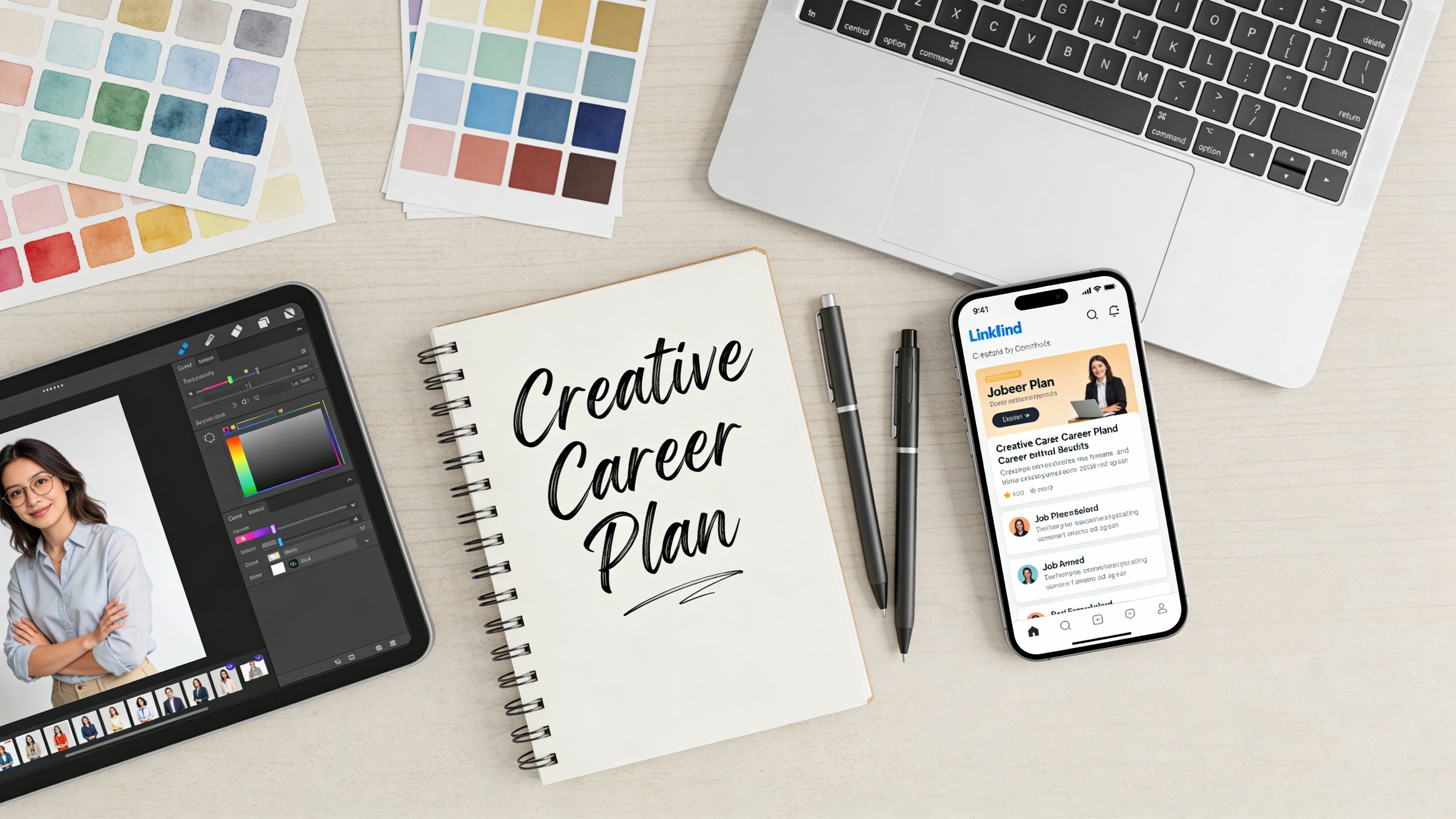
So, you want a career in the creative industries? Here’s what to look for when choosing the right training pathway

Before you sign up for a programme of study, start with the most important question: what kind of work do you want to do? If you’re not sure yet, that’s completely normal. A bit of research will help you figure it out.

Begin by looking at real job listings across areas that interest you — animation, design, film, gaming, content creation, photography, music, or any other creative fields. Pay attention to what roles spark your interest, the skills employers are looking for, and any patterns that show up across different jobs. If you spot a role that feels like your ‘dream job,’ reading the position description carefully can give you a clear idea of the skills you’ll want to build through your training.

Once you’ve collected a few examples, make a list of the skills that appear repeatedly. Creative industries change fast, but the skills employers consistently ask for give you a strong indication of what is currently in demand. This list becomes your starting point for figuring out what type of training will support your goals.

It’s also important to remember that studying is a major investment — not just financially, but also in time and energy. Once you know what skills you’re aiming for, compare different programmes and check how well they align with the direction you want to take. You want to be sure the training fits your needs, your interests, and your aspirations.

When looking at different options, choose programmes that are genuinely connected to the creative industries. Look for tutors or facilitators who are active in the field — people who are working professionals, researchers, or creators with up-to-date knowledge. Most institutions list staff bios on their websites, and these should clearly show industry engagement. Learning from people who work in the sector means you are more likely to gain relevant, current skills.

It’s also worth asking whether the programme has industry advisory groups, partnerships, or alumni networks that are genuinely involved in shaping what is taught. These networks help ensure that your learning reflects real-world expectations and give you valuable opportunities to meet the people who are already doing the work you want to do. Alumni networks can help you see the many different pathways graduates take and can give you insight into how people build sustainable creative careers.

Real-world learning is another essential component. Ask whether the programme offers internships, placements, or live client projects. Opportunities to apply your skills in real situations help prepare you for the transition into work, and programmes with strong industry connections can often see students moving into jobs even before they finish their qualifications.

Finally, look for programmes that understand the realities of creative work. Many creatives switch between employment and freelancing, so the programme should prepare you for both. You’ll want the freedom to explore different pathways and build the confidence to take opportunities when they arise. Ideally, the programme should also offer flexible options so that if you are offered an internship or job while studying, you can take it and continue working toward your qualification.

Choosing the right creative industries training is about finding a programme that connects you with real professionals, teaches the skills employers are looking for, and supports your transition into the creative workforce. With the right foundation, you’ll be well-placed to build a creative career that is both exciting and sustainable.

Why Regional Vocational Training Takes a Community

Vocational training in New Zealand has been on a rollercoaster for years — restructures, closures, shifting priorities, and constant uncertainty. Skilled people have left the sector, and programmes have disappeared. In the South Island regions, the impact is unmistakable: access to hands-on tertiary training is shrinking, and more people are being pushed toward online-only options or relocating to major centres.

These days, every region needs opportunities for people of all ages to upskill, reskill, and adapt to rapid change — from evolving technologies to shifting customer expectations. Industries need capable, creative workers. Communities need people who can step confidently into new roles as the landscape transforms.

And this is where the current structure often fails the regions. Large, centralised institutions tend to move slowly. Redeveloping programmes, responding to emerging needs, designing new solutions — these processes can take years. Vocational training, however, needs to be able to pivot quickly, especially as industries evolve at speed. This is where the regions have historically been strong. Regional communities, employers, educators, and councils have shown time and again their ability to come together, innovate, and create practical solutions that meet their own needs.

When programmes are designed from a distance, without deep connection to local industries or context, they risk becoming disconnected from the very places they are meant to serve.

Vocational training takes a community who understand the region’s realities — its challenges, industries, aspirations, and potential. It requires employers who are willing to partner and mentor. It requires learning facilitators who can deliver programmes grounded in place, responsive to local demand, and flexible enough to support both full-time and part-time learners. It requires iwi, councils, and community organisations who help shape pathways that genuinely reflect local needs.

And crucially, it requires the agility that only communities themselves can create. No one cares more about a region’s success than the people who live and work within it.

That’s why the regions need the autonomy to build their own solutions — vocational pathways that are locally governed, designed, delivered, and able to adapt quickly.

If we want strong, resilient regional economies, we can’t rely on centralised one-size-fits-all models or wait for solutions to filter down from elsewhere.

It takes a community to build vocational training that truly works — and the regions are ready to lead.

Learning How to Learn: Why Curiosity Matters More Than Compliance

As I sit with my sprained ankle raised, unable to move much, I’ve been thinking about education — and more specifically, how we learn.

How to solve problems and adapt to new contexts is fundamental to learning. Even something as small as working out how to manage daily life with limited mobility has required fast adaptations — getting food, reaching the washing line, navigating stairs. These are small but real reminders that learning isn’t just about absorbing content; it’s about applying thinking in new contexts.

Having been involved in New Zealand’s education system for most of my life — as a student, educator, and leader — I keep returning to one question:
Are we really teaching people how to learn, or just instructing them to meet pre-determined standards based on our experience of education?

We talk a lot about innovation, but too often our systems reward compliance over curiosity. One consistent skill our education system teaches — intentionally or not — is how to follow institutional processes, meet metrics, and navigate bureaucracy rarely designed with learners in mind.

Yes, that prepares people for navigating institutions. But it also reduces learning to procedural compliance. It becomes something you acquire through qualification — tick the box, move on. But real growth doesn’t follow that trajectory.

Staying in your comfort zone isn’t learning. Fighting to preserve a status quo that no longer serves is also not learning. Education can become a trap. We grow confident in what we already know and stop questioning how we know. We become protectionist about the things we learned in the past, convinced that because it worked for us, today’s learners should simply 'take their medicine.'

A colleague recently reminded me: curiosity is too often missing in education. And it matters. Curiosity drives us to explore what we don’t know rather than defend what we do. It invites questions. It fosters exploration rather than just passing on information.

The ability to learn — to think critically, explore creatively, and adapt with agility — is a lifelong skill, not something confined to any classroom. Yet we still prioritise structure over imagination, and assessment over ambiguity.

So, I find myself asking:

Are we preparing learners for complexity, or just for benchmarks?

Are we protecting outdated models because they serve learners — or because they protect us?

Are we resisting change because it feels risky to what we already think we know?

These aren’t easy questions. But they matter. Because if education is to stay relevant, it needs the courage to evolve — and that starts with curiosity.

Evolving Art History: From Tradition to Critical Visual Literacy

With art history evolving across education at all levels, I’ve been reflecting on its potential to equip learners for today’s image-saturated world.

At its best, art history has always been about more than artists and movements. It teaches us to read images — to ask who made them, why, and how they became part of art history, including questions of representation and cultural context.

Today, access to images has changed dramatically: they are available on demand, 24/7, across mainstream media, social media, streaming platforms, video games, and AI-generated content. That constant exposure makes the ability to engage critically with images more important than ever.

The democratisation of image-making has also changed the game: anyone can upload a video, create a documentary, design a game, or generate AI content. This raises critical questions for learners: Who created it? Why was it made? Whose perspectives are represented, and whose are missing? What impact does it have on audiences and culture?

At the same time, the reality is that not enough learners are choosing art history, which means its value is often not fully understood. The pathways into creative industries are also complex: over 80% of people working in the sector don’t hold formal creative qualifications, and of those who do, most do not go on to work in the field. This highlights the need for a curriculum that equips all learners with the skills to engage critically with visual culture — whether or not they follow a creative industries pathway.

Some questions I keep returning to:

Should art history continue as a standalone subject, or be integrated into a broader curriculum of visual culture and media literacy?

How can it combine theory, practice, and technology to remain relevant and engaging?

What value does it bring to learners making subject choices with future careers in mind — in design, marketing, journalism, politics, or education?

How do we ensure it develops pressing real-world literacies while maintaining the cultural depth that has always made it meaningful?

Reimagining art history isn’t about replacing it — it’s about enhancing it. By connecting traditional knowledge with contemporary visual culture, we can equip learners with the tools to critically interpret and engage with images across all platforms, from classical artworks to AI-generated content.

The ability to question, decode, and contextualise images is more than an academic skill — it’s a vital competency for navigating the 21st century.

Rethinking Art History: Beyond Advocacy

There is a lot of current dialogue about the removal of art history from New Zealand schools, and it’s prompted me to reflect on my own journey with the subject. I studied art history throughout my education. At secondary school, I can’t say I enjoyed it much (Gombrich and I never really saw eye to eye). But when I reached art school, everything changed. There was more freedom to explore areas that connected directly to practice, to dive deeply into ideas that felt urgent. This re-inspired my interest and showed me how art history could be more than simply a timeline of selected practices, artists and movements.

Reading responses calling for art history to be reinstated in schools makes me curious about the bigger picture. Its decline hasn’t happened overnight — this has been a global trend for decades. I honestly can’t remember when I first joined debates about the closure of programmes and departments, because it feels like they’ve been going on for a long time. If we’ve been aware of this precariousness for so long — with enrolments dwindling and ‘viability’ constantly questioned — what has actually been done to sustain art history as a standalone subject?

That’s the question I keep returning to. How has art history evolved to meet the needs and interests of new generations? Do we understand how people want to engage with it? Should it even still be called ‘art history’? Does it need to be strictly theoretical, or standalone? Can it be integrated with practice? How do we make it meaningful for young people who are making subject choices with future careers in mind — which many do?

Simply advocating for a subject that few want to study — while understandable — doesn’t solve the underlying issue. We need to think creatively about how art history (or whatever we call it) can be made relevant, accessible, and compelling for learners today.

For me, the issue isn’t about reinstating art history in schools but about reimagining it for learners navigating a very different world. What does it need to look like to be compelling and useful today? How can it be contextualised for relevance? And how do we ensure it’s not just surviving, but thriving, as part of our cultural and educational landscape?

We can’t turn back time — so what should art history look like now?

Why Media Literacy Belongs at the Heart of Education

There is currently a lot of discussion about the removal of art history from our schools, and yes, I did study art history at school and later throughout my tertiary study. So, while these important dialogues are circulating, I will advocate for what I believe is currently a critical gap in young people’s learning in NZ.

Having had the pleasure of working with thousands of young people making the transition to tertiary education over the years, I have noted a critical gap that is only becoming more urgent: the lack of systematic media literacy training.

Young people are surrounded by media from the moment they wake up to the moment they fall asleep. News feeds, social platforms, advertising, podcasts, influencers, and increasingly, AI-generated content shape how they see themselves and the world. Yet for many, the ability to critically question and navigate this landscape is left to chance.

While some schools offer Media Studies, this is not enough. Media literacy should not be optional—it is a core competency for life in the 21st century. Just as we teach students to read books, solve equations, or understand science, we must also teach them to read the media world they live in every day.

Why does this matter?

Democracy depends on it. A population unable to distinguish credible reporting, misinformation, and AI-driven fakes is vulnerable to polarisation.

Wellbeing depends on it. Young people need tools to recognise harmful patterns and build resilience in the face of persuasive algorithms.

Economic futures depend on it. Every career now intersects with digital and AI-driven communication.

Culture depends on it. Media is where our stories live, identities are expressed, and values debated.

Media literacy equips learners with critical thinking, creative production, and ethical awareness. It asks questions such as:

Who created this—or was it AI—and why?

What techniques or algorithms are used to influence me?

Whose perspectives are excluded?

How does this content make me feel, and why?

Without these skills, we risk raising generations who consume without question, who struggle to separate fact from opinion, and who are unprepared for the realities of an AI-driven society.

The urgent need is clear: media literacy must be embedded across schooling, not as an elective but as a foundation. Imagine if every learner graduated able to analyse both human and AI-created content, create responsibly, and engage constructively in the digital public sphere. The benefits would extend far beyond the classroom—to stronger communities, healthier democracies, and more empowered young people.

It’s time to treat media literacy as seriously as reading, writing, and maths. In today’s world, it is just as fundamental.

What if creative vocational training became the bridge into one of NZ’s fastest-growing sectors?

Right now:

80% of people working in the creative industries don’t hold formal creative qualifications.

Over 80% of those who do earn creative qualifications do not enter the sector.

This mismatch shows that while our education system produces talented graduates, it doesn’t always connect them to the industry where their skills are most needed. Yet the creative sector is now New Zealand’s fourth biggest export earner, more productive than agriculture, and central to our identity on the world stage.

So what if vocational education became a bridge—connecting learners to the real-world creative economy in all its forms?

Imagine if…

Every qualification is a pathway. Certificates, diplomas, and degrees are stackable credentials completed while in work, rather than requiring long periods away. Institutions act as conduits, co-creating programmes with industry so learning serves both learners and sector needs.

Industry engagement is consistent nationwide. All programmes have industry advisory groups that support a steady stream of emerging professionals transitioning into work. Imagine if embedded, active partnerships were the norm everywhere.

Alumni networks are part of the ecosystem. Alumni who are in industry are connected back to those entering, creating a living bridge where knowledge, mentorship, and opportunity flow both ways.

Education keeps pace with change. Institutions iterate quickly, co-designing micro-credentials & short courses with industry so learners stay relevant.

Mentorship and lived knowledge are embedded. Structured mentoring connects learners to practitioners who pass on tacit skills, networks, and sector insights.

Learning happens in work, not apart from it. The industry itself is the classroom—an incubator of innovation shaping NZ’s creative, cultural and economic future.

Much like any sector, creative industries learning must be grounded in the real world of work. That’s how we ensure learners don’t just earn qualifications—they find meaningful, sustainable careers.

The opportunity is here. The question is: what if we designed creative industries education to be as dynamic, adaptive, and innovative as the industries it serves?

Read the article: Creative sector NZ’s fourth biggest export, more productive than agriculture, report finds | The Post

What if we stopped thinking of museums as just places you visit—and instead as global content creators & educators?

Museums have always been producers of content and education. But there’s never been a better time to capitalise on the shift away from centralisation toward more dynamic, diverse ways of connecting with audiences. Whether your museum is volunteer-run or equipped with a professional production team, the opportunity is now. With limited and low-cost tools, even the smallest museum can reach a global audience—no matter how niche its collections or stories.

And if your organisation lacks expertise, there is an incredible diversity of free online resources to help you get started. You can also engage digital natives through internships or placements—essential pathways for young professionals to hone their craft and build new skills. Your museum has value, and it’s time to recognise it.

The Tank Museum shows what’s possible when a museum fully embraces video. With a professional production team, it has built one of the world’s most successful museum YouTube channels—transforming a highly specialised subject into global entertainment and education. I never imagined I’d find the history of tanks so compelling until I engaged with their content. That’s the power of storytelling: it makes people care about subjects they never thought were for them.

This shift speaks directly to education. Learners today expect to design their own journeys—choosing what, when, and how they engage. Centralised classroom-based education has significant limitations, creating a gap that museums can fill. Want to understand the gaps your museum could address? Engage with your communities, listen to their needs, and build learning solutions that matter.

The possibilities are rich: educate and entertain through video, create immersive experiences with animation, gamify learning to make it interactive, collaborate with education providers, offer modular online courses, hybrid models, flexible pathways, or short stackable modules. When developing your content strategy, remember media and entertainment have a lot to teach us about audiences and storytelling. Watch, learn, and adapt. Museums—keepers of deep knowledge—can deliver compelling, relevant, and globally accessible content that meets audiences where they are.

The opportunity is here, and the movement is already happening. Will your museum choose to be part of it?

#MuseumInnovation #DigitalStorytelling #OnlineEducation #GamifiedLearning #CulturalInfluence #FutureOfMuseums

What happens when we stop waiting for institutions to lead — and start building experiences together

For the past 25 years, I’ve worked across public galleries, community and artist-run spaces, and creative industries education, and I’ve facilitated numerous projects in spaces and places shaped by the voices of the people who use them.

Alongside this, my PhD research into DIY Museums immersed me in community-led initiatives where stories are told by the people who live them. These experiences showed me something powerful: when people are trusted with the tools, skills, and agency to create culture for themselves, the results are bold, relevant, and deeply connected.

That’s the opportunity we’re standing in front of right now.

The pace of change is faster than ever. Whether you’re a business, an educational provider, or a cultural organisation, meeting your audience where they are — in how they live, learn, connect, and consume culture — is no longer optional. Those who listen deeply, adapt quickly, and co-create meaning will not only survive, but thrive.

Imagine if every project, initiative, or experience began not with “what do we want to make?” but with “what matters most to the people we serve — and how can we build it together?” That’s when creativity becomes magnetic. That’s when people show up, participate, and share.

As I step into running my own creative business, this is the work I want to do: help organisations, businesses, and communities design experiences that feel participatory, relevant, and alive — spaces where the audience is not just watching but shaping what happens.

So here’s my question for you:

If you’ve worked in creative industries, education, or community culture — what’s one change you believe would make these experiences more relevant, inclusive, and alive right now?

I’d love to hear your thoughts — whether they’re big, structural shifts or small, practical actions you’ve seen make a real difference.