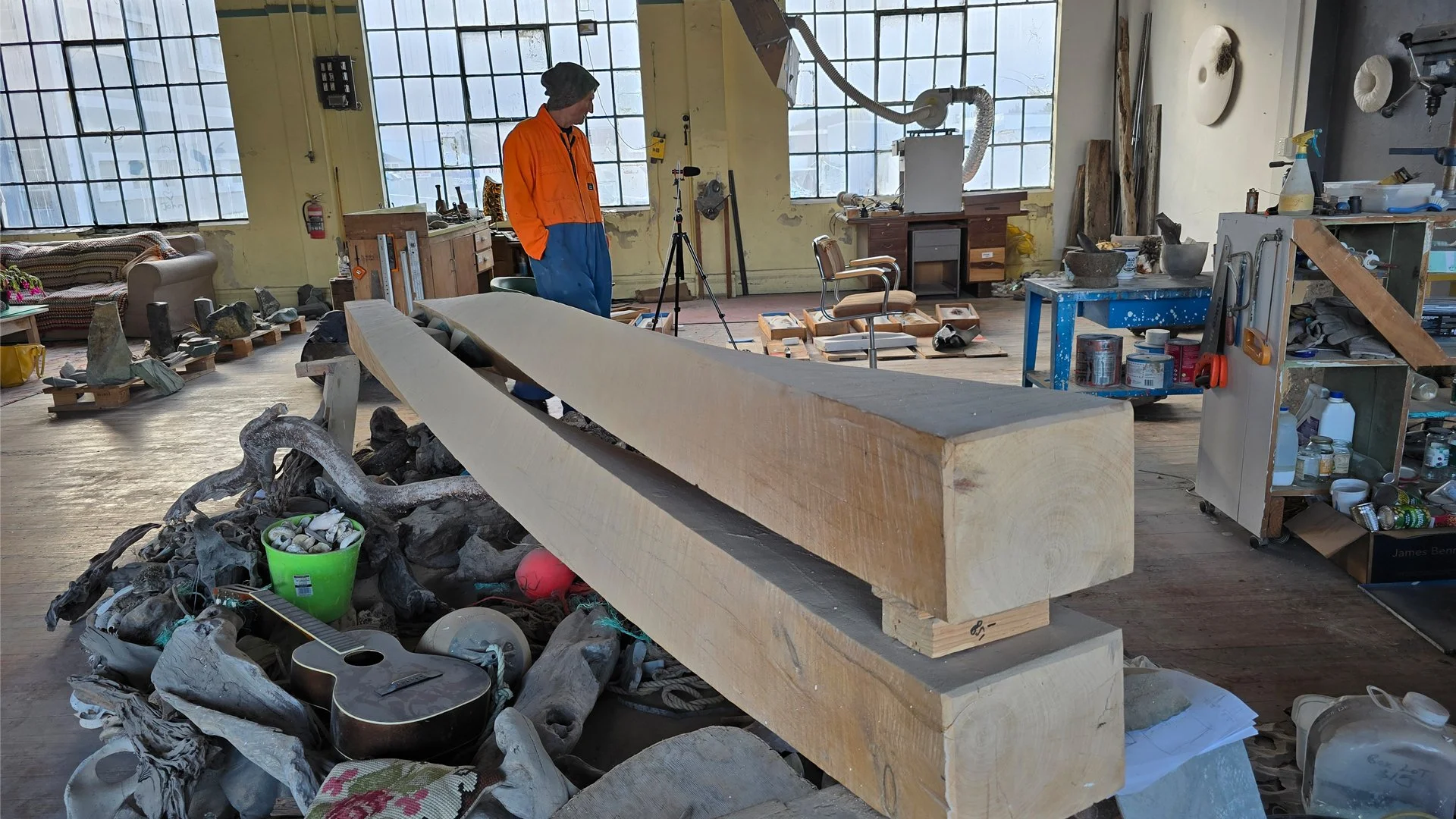
Fractured sunlight streams through the studio windows illuminating these abandoned things. Years of foraging overlooked remnants of past lives, industry once productive and valued. Smoothed, encrusted and transformed by the tide before being cast ashore, these collected abandoned things rest for a time, waiting to be newly reconfigured by the elements of the studio.
Sorted, piled, juxtaposed and integrated, these abandoned things are brought back into consciousness and questioning. A forgotten industry swallowed by the sea – an abandoned ‘Works’ at Ocean Beach in Bluff. “The Beach” both site and archive: a fossil of environmental intervention, a local economic ‘backbone’, traces of a century of labour and culture.
John Wishart gathers these hybrid artefacts and uses them not only as found objects but as points of departure. He creates new sculptural forms inspired by their ambiguities—objects that hover between the recognisable and the unfamiliar, the organic and the engineered. We are invited to ask: Is this naturally formed or man-made? This ongoing tension is central to the work, for it mirrors the very uncertainty produced by the sea’s intervention. By blurring categories of origin, the sculptures complicate our assumptions about material histories, authorship, and the boundaries between industry and ecology.
Abandoned Works speaks not only to the derelict freezing works but also to the idea that these objects—and Wishart’s sculptures inspired by them—exist in a state of becoming. Like archaeological fragments, or museum artefacts excavated from uncertain contexts, they appear suspended in time: neither fully of the past nor the present, neither wholly finished nor truly discarded. Weathering, erosion, and accretion become forms of authorship. The sea continues the work that industry began, and the artist, in turn, extends this chain of transformation. Each sculpture captures a moment within an endless cycle of making, unmaking, and remaking.
Abandoned Works preserves traces of an industry that once underpinned the local community, sustaining labour, culture, and livelihoods, yet whose significance was swiftly lost to time. These objects testify to the fragility of value, both material and social, and the ways in which human endeavour is shaped—and sometimes undone—by forces beyond our control.
In the studio, Wishart’s sculptures extend this dialogue: they are never finished, only abandoned, entering a state of suspension between making and letting go. Each piece captures a moment within an endless cycle reminding us that artworks, like communities and landscapes, are provisional, open to change, and inseparably entwined with the passage of time.