Beyond the Logo: Designing Brand-Aligned Spaces That Tell Your Story
What does it mean to paint in the landscape?
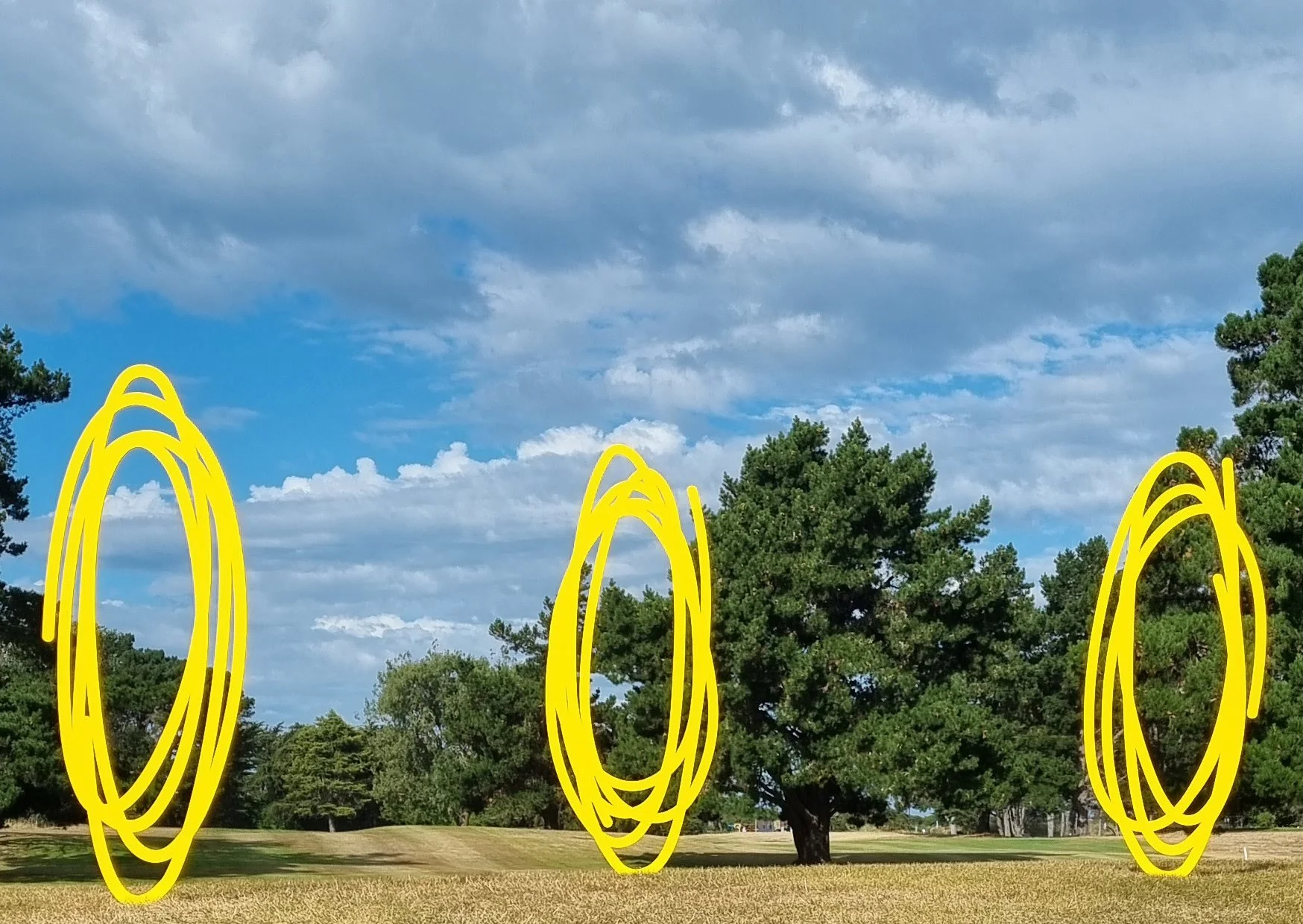
What does it mean to paint in the landscape? To create portals that appear digitally superimposed, unnatural, disconnected, yet undeniably present. Like stumbling across a painting you have somehow miraculously stepped inside when you were convinced it was simply a photograph. A process you have entered and become a part of. Witness to the dynamism of scribbled loops rendered digitally into monumental, bold yellow environmental, almost architectural intrusions.
Nathan Ingram’s Superimposition Loops translate small, hand-drawn gestural marks into monumental forms, expanding the immediacy of painting into sculptural intervention. Each scribbled, extended loop carries the energy of a drawn line, amplified. They evoke moments reminiscent of Who Framed Roger Rabbit (1988), where cartoons exist against the backdrop of filmic reality—like Eddie Valiant approaching a dark tunnel, uncertain of what awaits in Toon Town.
By projecting these painterly gestures into landscape, the sculptures create thresholds and frames through which the landscape becomes changed both physically and perceptually. They are points of pause, of reflection, and of reorientation within the environment. Each form resonates with a tension: it is both familiar and uncanny, abstract yet suggestive of habitation. In their presence, the act of painting becomes immersive, a record of gesture and precision, movement and stasis, simultaneously frozen and in flux.
These interventions ask us to reconsider our relationship to place, materiality, and creative process. The landscape becomes a canvas, yet one that is inhabited, navigated, and experienced. In translating painted gestures into environmental forms, the work underscores painting as a generative practice of experiential possibilities extending beyond the two-dimensionality of the wall. Each loop is a testament to the tension between creation and encounter, mark and monument, suggesting that painting is never fully confined—it spills outward, reshaping the world it touches.
By projecting these painterly gestures into the landscape, Ingram’s Superimposition Loops conjure thresholds where the ordinary dissolves into the extraordinary. Like stepping into a scene where the familiar terrain suddenly feels animated, uncanny, and alive—a place where imagination and reality collide.
Each monumental, scribbled loop retains the energy of a hand-drawn mark, amplified into bold, architectural presence, yet retaining the freedom and immediacy of its gestural origin. Even the most seemingly natural environment is revealed as layered and enchanted like a set where human mark-making in the landscape is rendered visible.