Across New Zealand, councils are investing in significant cultural facilities. As some approach completion, the projected costs of operating them are becoming clearer – in some cases, considerably greater than anticipated.
This raises an important question: what happens when the building is almost ready, but the cultural enterprise that will occupy it hasn't been adequately developed or tested against the realities of running it?
In an earlier post, I argued that developing cultural infrastructure is not simply an exercise in delivering a building. It is also about developing a cultural enterprise: establishing its purpose, audiences, activities, operating model and financial viability, and allowing these to inform the physical infrastructure.
Where that opportunity has passed, there is still work to do. Changing assumptions isn't an admission of failure; it can be responsible decision-making as better information emerges.
So what should councils do?
1. Establish the full financial picture. Identify the actual and projected costs of operating and maintaining the facility, including staffing, utilities, insurance, security, collection care and programming. Include longer-term asset costs and debt servicing. Equally, be realistic about income. Distinguish secured funding and reliable revenue from anticipated grants, sponsorship, donations and fundraising targets. Don't build an operating budget around optimistic income projections or assume fundraising will consistently fill a structural funding gap. Fundraising itself requires time, expertise and resources, and results are never guaranteed.
This isn't about expecting cultural facilities to be commercially self-sufficient. It is about understanding the level of public investment required, what that investment will achieve, and whether it can be sustained.
2. Reassess the cultural proposition and the need it serves. What identified cultural or community need is the facility intended to address? Is there evidence of that need, and does the proposed offer respond to it? Who is it intended to serve, and what are the realistic population, audience and visitor markets? Are the original assumptions about demand, activity, opening hours and revenue supported by evidence? The scale and nature of the enterprise, and the resources required to sustain it, need to reflect the needs of its community and the capacity available to support it.
3. Identify the expertise needed to develop and deliver the enterprise. Map the skills within the council, project team and proposed operational leadership. Cultural professionals bring vital expertise in collections, programming, audiences and community engagement, but may not have experience developing cultural enterprises, operating models or financial plans. Identify what expertise is already available and where additional capability is needed.
4. Develop and cost alternative operating models. Don't assume the original model is the only option. Consider different programme scales, staffing structures, partnerships, shared services, uses of space and approaches to audience development and revenue. What combinations could deliver the strongest cultural offer within realistic financial parameters? What would each require, and what would it achieve?
5. Resource the chosen model realistically. There can be a temptation to preserve the original vision by creating roles that combine several distinct areas of responsibility, expecting a small team to deliver an extensive programme and range of services. This may look like a way to contain costs while maintaining the promised offer, but it can compromise the entire operation.
People cannot sustainably perform several specialist roles simply because the budget or organisational structure hasn't made provision for them. The result can be an overstretched team, diluted expertise and a facility that struggles to deliver any part of its proposition effectively.
It is better to establish a properly resourced, viable operation at a realistic scale, then build staffing, programmes and services as audiences, demand, capability and funding develop. This isn't a lack of ambition. It is recognising what it actually takes to develop a successful cultural enterprise.
This may also mean staging the transition into full operation, allowing time to establish the organisation, build partnerships and develop audiences before expanding programmes and services.
The people responsible for leading and operating the facility need to be involved in developing the enterprise and have a clear understanding of its operating model and budget. They may not have all the specialist expertise needed to develop the enterprise themselves, but their practical knowledge is essential to shaping something that can work. They should not simply inherit a predetermined model and be held accountable for making it work.
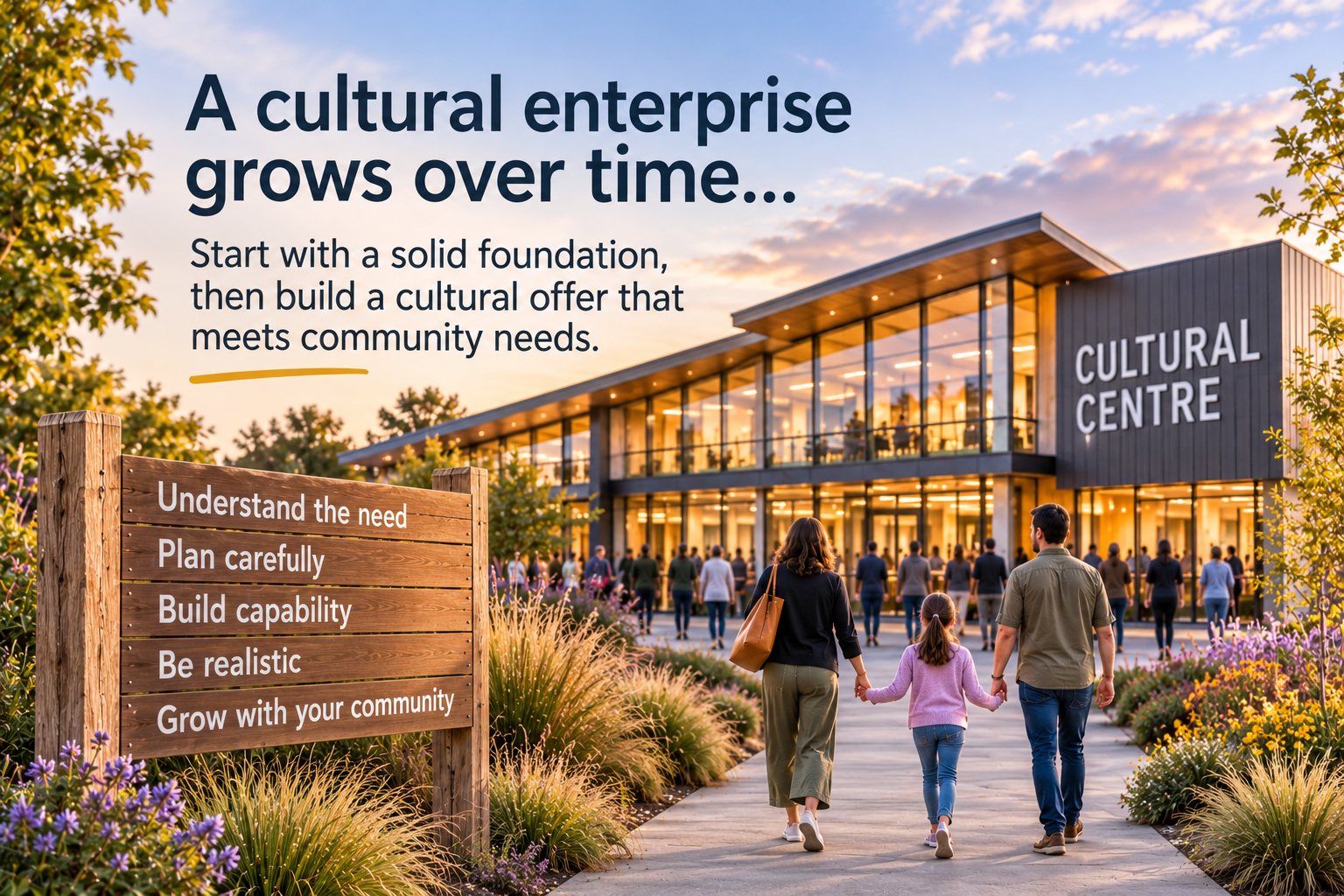
The building is the asset; the cultural enterprise is what gives it purpose and creates lasting value for its community. A successful cultural facility doesn't need to deliver everything from day one. It needs a viable foundation from which its cultural offer, audiences and impact can develop over time, responding to the needs of its community and the opportunities that emerge.