New Zealand's tertiary education sector is approaching a significant demographic shift.
As birth rates continue to decline, the pool of school leavers entering vocational education will become progressively smaller. Competition for traditional learners will inevitably intensify. Yet, while institutions focus considerable effort on attracting new school leavers, they continue to overlook one of their most valuable communities: their own graduates.
This raises an important question.
Why do we see graduates as former learners rather than lifelong members of our learning community?
Graduation has traditionally been viewed as the end of the educational journey. In reality, it should be the beginning of a different relationship.
Modern careers rarely follow a single trajectory. The pace at which industries are evolving means that today's graduate will need to continually upskill throughout their working life. Lifelong learning is no longer an aspiration—it has become an economic necessity.
Yet vocational education continues to behave as though learning finishes when a qualification is awarded.
This creates a significant missed opportunity.
Rather than continually investing in recruiting new learners, institutions could build lasting relationships with graduates who already know, trust and value the organisation. These graduates represent an existing community with an ongoing need for professional development, specialist training, micro-credentials, postgraduate study and career transitions.
The opportunity extends far beyond enrolments.
Graduates working across industry provide a direct connection between education and professional practice. They can inform curriculum design, identify emerging skills, support work-integrated learning, mentor current learners and provide staff with valuable insights into changing industry practice.
At the same time, graduates benefit from remaining connected. They gain access to professional development, networking opportunities, industry events, research, mentoring and learning that evolves alongside their careers.
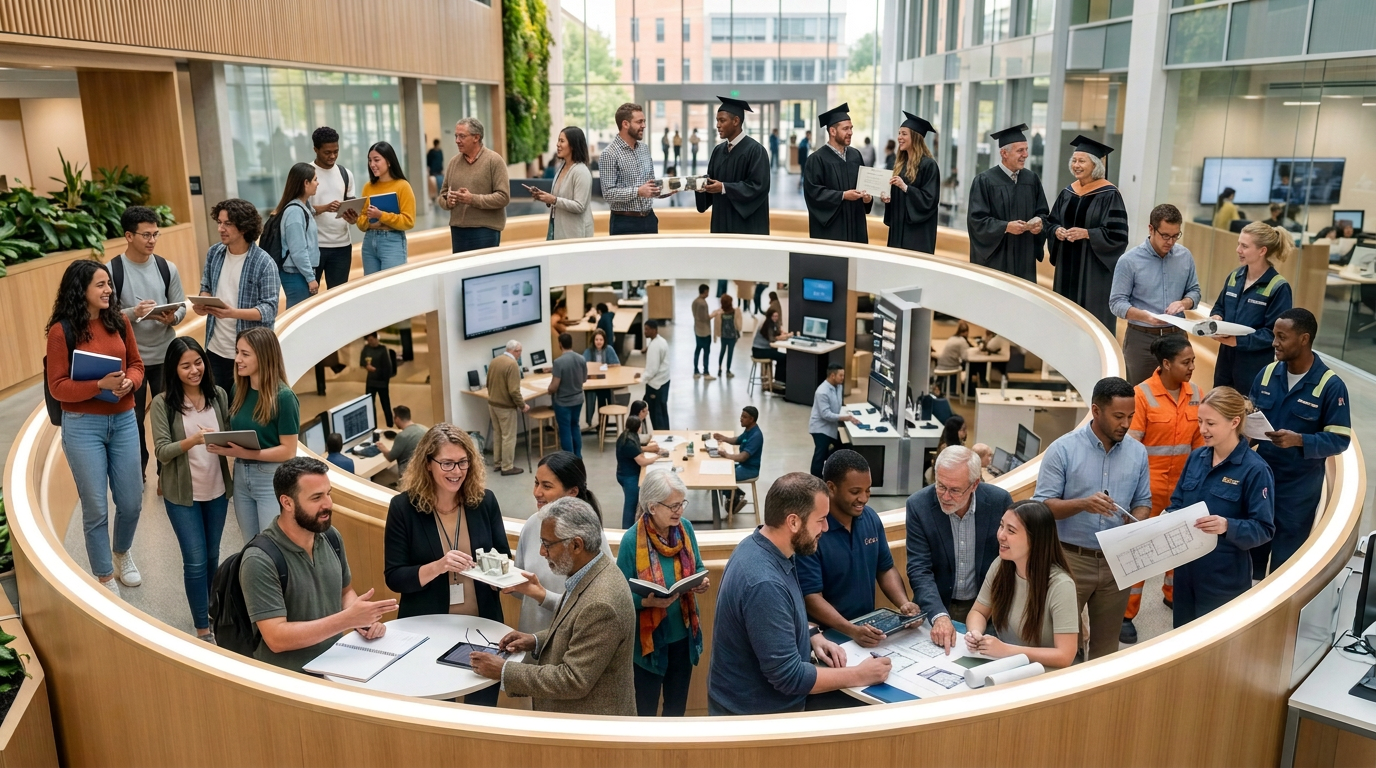
Instead of a one-way educational journey, the relationship becomes circular.
Learners become graduates.
Graduates become industry partners.
Industry partners become mentors.
Mentors become learners once again.
This creates an ecosystem where knowledge flows continuously between education and industry rather than ending at graduation.
As the number of school leavers declines, the challenge facing tertiary education may not be "How do we recruit more learners?"
Instead, it may be:
How do we create learning communities that people choose to remain part of throughout their careers?
The institutions that answer this question well are likely to be those that thrive over the coming decades.