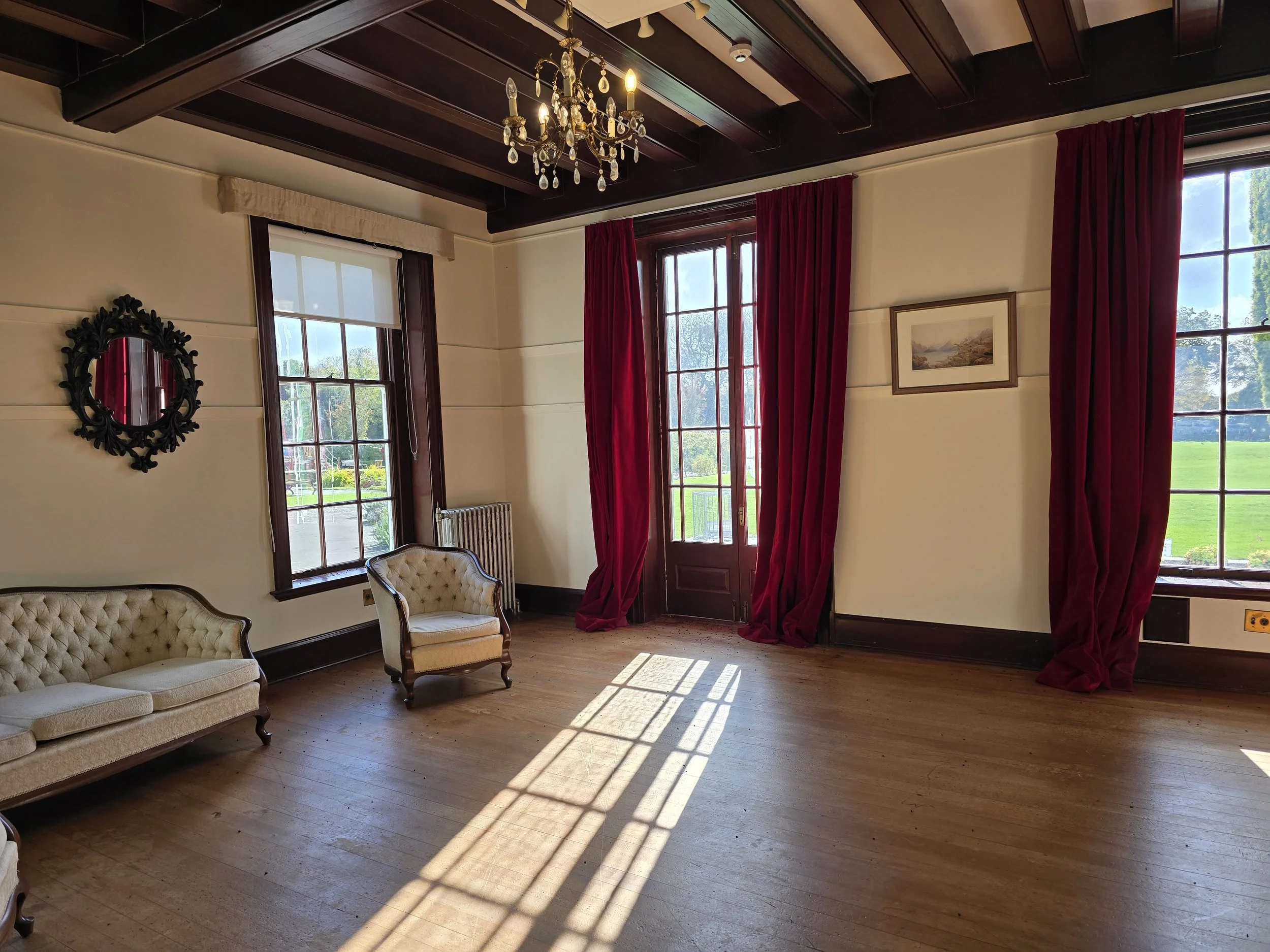
Rather than treating the building as a neutral container, the exhibition understands it as an active historical condition shaped by overlapping forms of occupation, storage, and display. It does not seek to replace or re-stage what was once held within it but instead works through the spatial consequences of that change. In doing so, the exhibition introduces an independent system of structures within the house that responds to both its domestic qualities and its former role as a repository of objects and cultural material. This approach is consistent with John McCulloch’s sustained practice of adaptive reuse, including significant work on historic building alterations and additions such as his office in Esk Street and his adjacent home, in which existing buildings were understood as evolving frameworks shaped through continued occupation and reinvention, as living forms rather than fixed monuments.
After reading through the archives, photographing drawings, and visiting a number of McCulloch’s projects across Southland, it became clear that the exhibition could only ever present fragments and moments from a career spanning more than forty years. McCulloch completed over 600 projects throughout the region, extending as far as Queenstown, and his work ranged from community buildings to submissions for projects such as the Buller Grove Housing Competition in Lower Hutt. The scale of this output meant the exhibition necessarily acknowledges incompleteness — that what visitors encounter are selected traces from a much larger body of work.
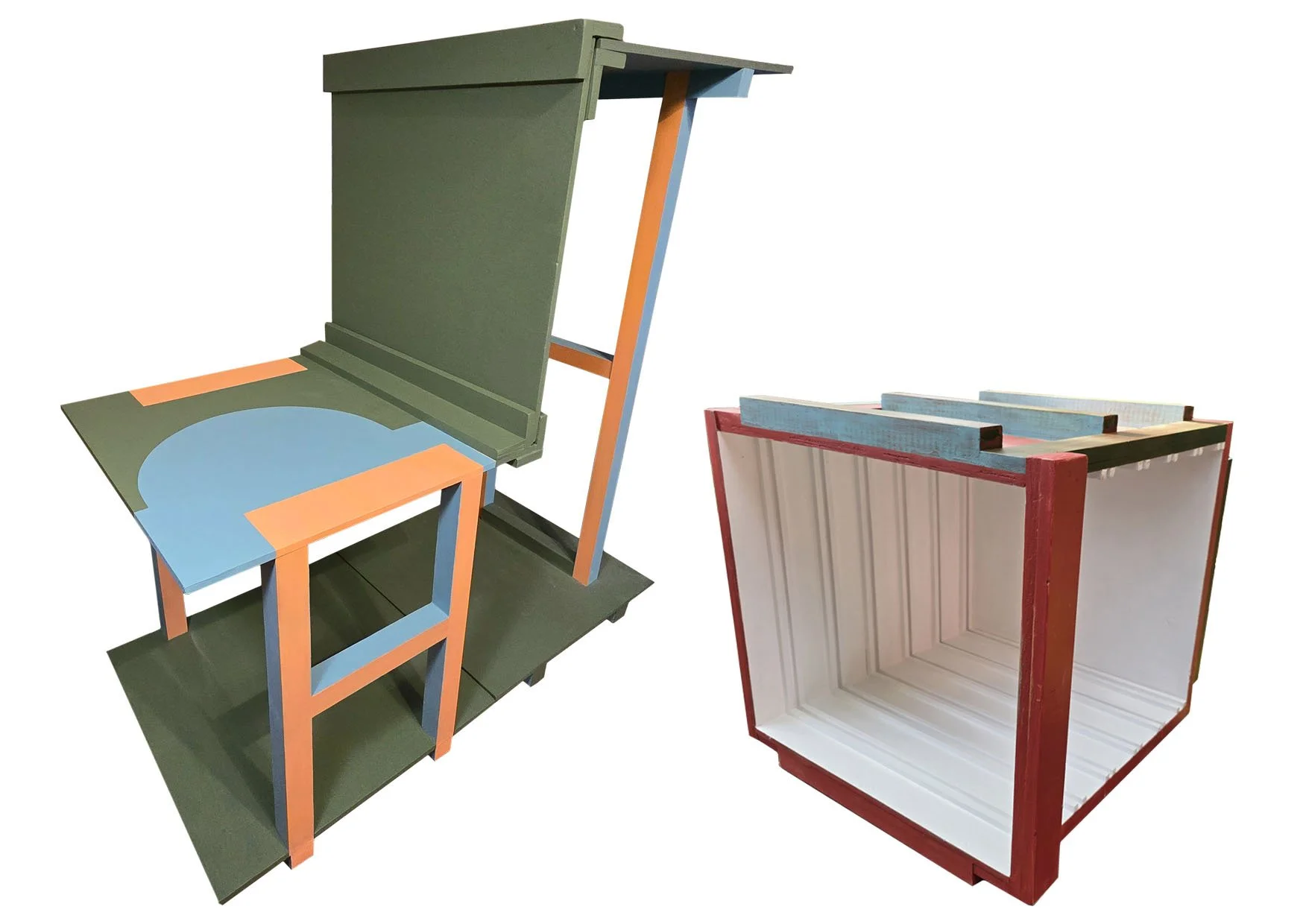
A recurring quality in many of John’s buildings is their operation almost as villages in themselves: clusters of spaces designed around connection, gathering, movement, and community interaction. Alongside the idea of storage and the archive, I wanted to reference this quality spatially by developing a series of structures derived from crate logics that visitors would navigate through and around. Each space presents its own “village” of community stories, with forms that vary in height, scale, and colour.
The forms of these structures were also influenced by miniature architectural models McCulloch created throughout his career. Encountering these models within the archive highlighted architecture not only as completed buildings, but as an ongoing process of testing, imagining, and spatial storytelling. In some respects, the exhibition structures operate like enlarged fragments of architectural models themselves — simplified constructions that visitors move through and around rather than view from a distance. This relationship between model, archive, and inhabitable space became an important influence on the exhibition experience design.
Further material within McCulloch’s archive included conference papers and essays by Eric Wesselow (1911–1998), a German-born, Montreal-based stained glass artist and advocate for art education in Quebec, whose proposition of a “universal model of art as a catalyst” emphasised expanded sensory engagement. In a 1998 lecture at Lonergan College, Wesselow described a form of cultivation that activates all the senses — a way of perceiving the world through touch, smell, sound, taste, and light, enabling a more intuitive and inventive relationship to environment and experience. His approach to stained glass was equally radical: most notably his removal of the traditional lead matrix, dissolving the dark structural lines between coloured glass in favour of continuous fields of light. This culminated in his 1960 commission for a mural of “light screens” at what is now Montréal–Trudeau International Airport.
In the exhibition, this sensibility is echoed through the use of clear and printed acrylic panels within the spatial structures. These surfaces act as layered windows into McCulloch’s projects, filtering imagery, drawings, and archival fragments through transparency and reflection. The acrylics will be encountered within the ambient daylight conditions of Anderson Park House itself, along with its original domestic lighting, so that light becomes an active medium through which the material is read rather than an external effect applied to it. As a building shaped by both domestic life and civic generosity — originally a private residence later gifted to the community of Invercargill for use as a public art gallery — it holds overlapping registers of intimacy and publicness. The exhibition responds to this condition as something already present within the architecture, allowing light to move through both the historic interiors and the installation, activating surfaces and shifting perception over time.
To extend this spatial and conceptual framework, the crate logic was developed as a thematic system that reflects the diversity of John McCulloch’s architectural practice. Rather than attempting to present the full scope of his work, the exhibition draws together fragments through interpretive groupings based on use, social function, and spatial intent. These include environments for learning and knowledge, domestic life, travel and tourism, heritage and restoration, community gathering, civic and infrastructural interventions, and commercial or trade-based activity. Rather than functioning as fixed categories, these groupings operate as overlapping ways of reading practice, allowing different aspects of McCulloch’s architecture to surface across the exhibition. The crate logic is not a literal formal system applied uniformly, but a curatorial and spatial reading framework that generates a range of experiential conditions, from enclosed volumes to open frames and layered surfaces.
In the exhibition space, these are translated into distinct spatial structures that visitors move between, each carrying variations in colour, scale, and material tone. The colour system reflects McCulloch’s architectural work in its full range: at times integrating with surrounding environmental and material conditions, and at times deliberately contrasting with them. Rather than forming a singular palette, colour operates as a contextual response, shifting between tonal restraint and bold interruption depending on the architectural logic being referenced. Together, these variations shape a shifting field of spatial experience, where each structure signals a different register of use and meaning within his broader body of work — a collective reading of architecture as social and spatial experience rather than fixed object or architectural category.
The structures are constructed from simple materials including plywood and pine, some of which was recycled from a previous billboard project in Southland. They are intentionally economical in construction, hand-built using basic tools and simple methods rather than specialist construction or fabrication techniques. The crate logic that underpins the exhibition is not a fixed or uniformly applied system of construction, but a conceptual starting point that evolves through iterative responses to individual projects. Rather than referencing McCulloch’s own methods of making, this approach reflects the conditions within which his architecture was often realised — including incremental development, and close collaboration with communities. This emphasis on practicality, adaptability, and material clarity aligns with the broader realities of community-focused architectural practice, where making is shaped as much by available means and collective process as by design intent.
The exhibition itself operates as an unfolding spatial inquiry rather than a fixed outcome, continuing to be shaped through ongoing research and engagement with the communities connected to McCulloch’s work.